Here are some highlights from my June 2014 Midsummer trip to Austria.


 Trikoot
Here are some highlights from my June 2014 Midsummer trip to Austria.
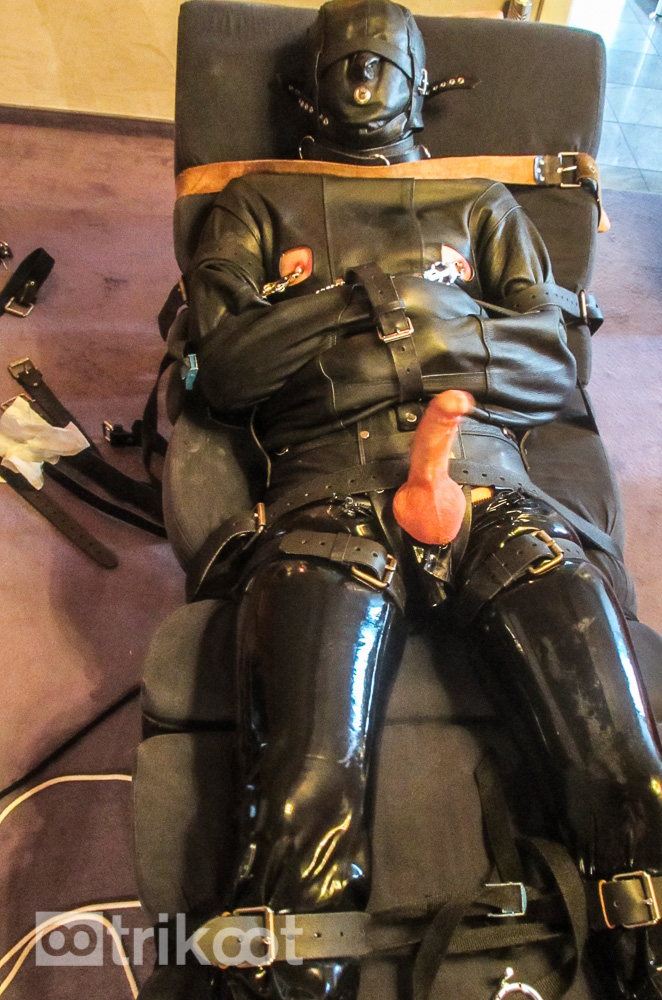
First test run of the popper delivery system on my bondage chair in my playroom in Espoo, Finland. Electro-induced orgasm included.
We all love rubber as a material, but at least for me, some of the less favourable features of rubber includes its strong friction against anything and everything, without suitable lubrication. This results in rubber clothing being occasionally difficult to put on, and uncomfortable to wear if the lube wears out. Also, excessive friction increases the tendency of rubber to tear.
Chlorination of rubber, which is the exposure of the surface of rubber to chlorine gas, aims to solve this problem. Chlorine, while interacting with rubber, changes the surface structure of rubber, reducing its friction.
This change can be dramatic: when I chlorinated a rubber catsuit I could not put on even with lubrication, after chlorination it slid on without any lubrication whatsoever.
While some rubber vendors have already started to offer chlorination as a service, it is extremely easy and cheap to do it home. I have chlorinated several pieces of my wardrobe, including a full catsuit, without any problems, and I am in the process of chlorinating my entire rubber collection.
WARNING: Chlorine gas is toxic and corrosive to lungs. Never do chlorination indoors, even in ventilated areas. Chlorine gas is heavier than air and will remain in areas, and possibly travel downwards in a building ventilation system. ALWAYS DO CHLORINATION OUTDOORS WHILE WEARING NECESSARY PROTECTION.
Before treating the rubber, it must be completely clean of all dirt, stains, grease and lubrication. Especially silicone is notoriously difficult to remove, but I have found dishwashing liquid to be a great help. Parts of the rubber covered by stains or lube will not be treated and will remain sticky after chlorination.
1. Fill plastic bucket 75% full of warm water.
2. Insert garment to be treated
3. Insert 400 millilitres of white vinegar and stir briefly
4. Wear your gas mask
5. Insert 300 millilitres of household bleach, and stir immediately for 60 seconds. You will notice the surface appearance of the garment change immediately. Do not expect bubbling or a dramatic chemical reaction.
6. Rinse the garment under clean, cold water and leave to air dry.
If you want to repeat the process, you can use the processing liquid again by adding again 400 millilitres of white vinegar and 300 millilitres of household bleach.
When sodium hypochlorite (NaOCl) is mixed with acetic acid (CH3COOH), the first main reaction is an acid–base step in which hypochlorite is protonated to form hypochlorous acid (HOCl) and sodium acetate:
NaOCl + CH3COOH <=> HOCl + CH3COONa.
If sufficiently acidic conditions are present and a source of chloride ions is available, a second reaction can occur in which hypochlorous acid reacts to form chlorine gas:
HOCl + H+ + Cl => Cl2 + H2O.
So, chlorine gas is not produced directly by acetic acid alone; it arises only after hypochlorite is first converted to hypochlorous acid and the necessary acidic, chloride-containing conditions are met.
Simple molarity-based stoichiometric calculations are not sufficient in chlorination of latex, because the reaction outcome depends strongly on pH, not just mole ratios. The first step (conversion of OCl to HOCl) is an acid–base equilibrium that only proceeds significantly when enough acid is present to lower the pH. The subsequent formation of chlorine gas requires not only hypochlorous acid but also sufficiently acidic conditions and available chloride ions. Therefore, it’s practical to have an excess of acetic acid in the solution at all times.


In 2013 I visited 18 foreign cities which are, in alphabetical order: Amsterdam, Antwerp, Berlin (three times), Chicago, Cologne, Copenhagen, Hamburg, Koblenz, London, Luxembourg, Oslo, Paris, Prague, Pärnu, San Francisco, Tallinn, Vienna, and Zürich.
I travelled for 58 nights, of which in hotels I spent 36 nights, on airplanes 2 nights, at friends 15 nights, and in apartments 5 nights.
I met 46 separate foreign persons in meaningful, private meetings. Of those there is 1 person I never want to meet again, but you do not know who you are.
Most common name among my encounters was Florian with 3 persons sharing that name.
I had 37 private sessions in foreign cities, parties and public events excluded.
Last September me and a local friend did some photos with Jouni Nieminen, who is an extremely talented photographer with a meticulous eye for detail. The pictures also feature my friend’s Honda CB-1000R.